
heyo, here is my last lab report of the semester! I can’t wait to start posting about summer adventures instead of assigned writing [barf]. To the future!
The Effect of Different Light Wavelengths on the Rate of Photosynthesis
Rateliff, K.
Biology 1440
Dr Puri, Tuesday PM
Introduction: Photosynthesis is how plants harbor the light to undergo cellular respiration, or a metabolic process which turns “radiant” sunlight energy into chemical energy (Karafit et. al. 2020). Most plants have a green color to them by chlorophyll, and as a result blue and red light are the light wavelengths which allow the plant to thrive (Urry L. A. et. al. 2020).
The purpose of this experiment is to observe photosynthesis through gas release of spinach leaves when exposed to different wavelengths of light. Spinach was chosen for this experiment because its leaves stay “metabolically active” for days after harvesting. If light is the energy source for photosynthesis with CO2 being the input and CO2 the output, and specific light wavelengths cause more effective photosynthesis than others, then of the color light wavelengths tested green and the dark would yield higher CO2 rates and white, red, and blue would yield higher O2 rates.
Methods: Following the procedures in the lab manual, several spinach leaves were collected and weighed as a whole before placing them in the chamber provided. Two holes which were in the chamber allowed for both the CO2 and the O2 probe to measure without influence of the open air. In order to test different color wavelengths, foil covered the surrounding chamber except for where the light was going to shine through the top, where the colored filter would be placed. For each trial of all wavelengths, red, green, blue, and absence of light, the leaves were incubated in the treatment for five minutes before measuring the CO2 and O2 levels. The gas levels were measured for five minutes before measuring, and in between each trial the probes were aired out to the gas levels of the room by a fan (Karafit et. al. 2020).
Results: For the white light, which encompasses all wavelengths, there was an average of -0.372697 ppm of CO2 and 0.000268347% O2 levels. For each gas measured, the red and the blue light measured near an equal amount of CO2 and O2 concentration. The CO2 concentration had a steady increase from white to green light before dropping 17% under the blue light. After that there was a slight increase in CO2 concentrations in the dark of 12%. For O2 concentrations across the experiment there was a steady decrease, more sharply between white light and red, which was 3%. From red light, green light, and blue light, the percentages were, on average, at a plateau. However, there was a 15% concentration decrease between blue light and darkness.
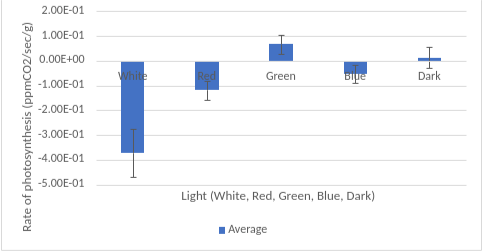
Figure 1. CO2 levels (ppm) from spinach leaves after being incubated in different wavelengths of light for 5 minutes (n=6 per data point)
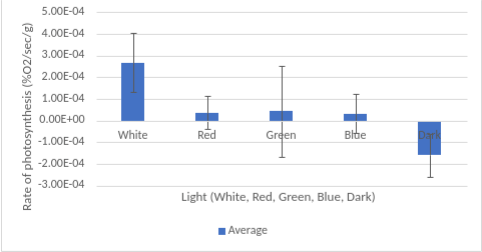
Figure 2. O2 levels (%) from spinach leaves after being incubated in different wavelengths of light for 5 minutes (n=6 per data point)
Discussion and Conclusion: The results of the experiment supported the hypothesis that CO2 levels would rise in the green and darkness while they would lower in red, white, and blue light. The hypothesis also supported that the O2 levels would rise in white, red, and blue light while the levels would decrease in green light and darkness. This can be explained by the fact that oxygen is a byproduct of cellular respiration during photosynthesis. Because most leaves are green, including the model organism for this experiment, spinach. Plants will take up light wavelengths that are not green. CO2 levels are higher in wavelengths such as green, because the spinach leaves cannot undergo photosynthesis under that light. New experiments can be conducted on if temperature also affects the rate of photosynthesis in conjunction to light wave colors. For each wavelength, multiple temperatures are used to measure CO2 or O2 concentrations on spinach leaves. This would be relevant to the study of photosynthesis because it would measure the optimal temperature for that process to occur and explain why some plants fare better in different climates than others. The hypothesis would be that the hotter the temperature, the more O2 is released until entropy occurs and decreases the O2 concentrations, while CO2 will be lower in higher temperatures until entropy occurs and increases the CO2 concentration.
Literature Cited:
S.J. Karafit, Choinski J.S., Jr., Runge, S.W. (2020). BIOL 1440 Laboratory Manual (5th ed.). Plymouth, MI. Hayden-McNeil, LLC.
Urry L. A., Cain M.L., Wasserman S.A. and Minorsky P.V. (2020) Campbell Biology In Focus (3rd ed.) San Francisco, CA. Pearson Benjamin Cummings.


That’s so cool!
LikeLiked by 1 person